What Most People DON’T Know About Carbon Monoxide (but really need to)
Here you will find links to resources, information, and research on carbon monoxide. This page will be continuously updated as I find more information. I still have scads more to add.
I have put an emphasis on low level carbon monoxide poisoning. Currently, home carbon monoxide detectors do NOT pick this up, nor are they designed to. They are only designed to prevent death, not poisoning.
Home CO detectors in the United States currently have an alarm set point of 70 parts per million (ppm). The safe level for your home is 0-5ppm, (3-5ppm can cause symptoms for some for susceptible populations).(updated 2/20/2024) Firefighters wear protective gear at 35ppm.
“the UL2034 standard prohibit {Home carbon monoxide detectors} from alarming unless the CO level has been CONTINUOUSLY at or above:
70 ppm for 1 to 4 hours,
OR
150 ppm for 10 to 50 minutes
OR
400 ppm for 4 to 15 minutes.These delays, of course, insure that by the time the alarm sounds, any people or pets in the home will already be CO poisoned.”
Albert Donnay, Toxicologist and Environmental Health Engineer
There are personal CO detectors that will pick up 1ppm and up. These are used by plumbers and HVAC professionals. I highly recommend everyone own one, especially if you have gas appliances in your home. Even if your home is all electric, keep traveling in mind. Friend’s homes, autos, workplaces, and hotels (even swanky resorts) may have CO issues. I have a Sensorcon, but there are other brands. You are not likely to find these at a home improvement store. I found mine on Amazon.
Carbon monoxide is not caused by a gas leak. Unlike a gas leak, you cannot smell CO. It is a byproduct of combustion from oil and gas appliances (natural gas, propane, kerosene, etc.), wood burning/trash burning, charcoal, automobiles, generators, boats, paint remover, hookah smoking, etc.
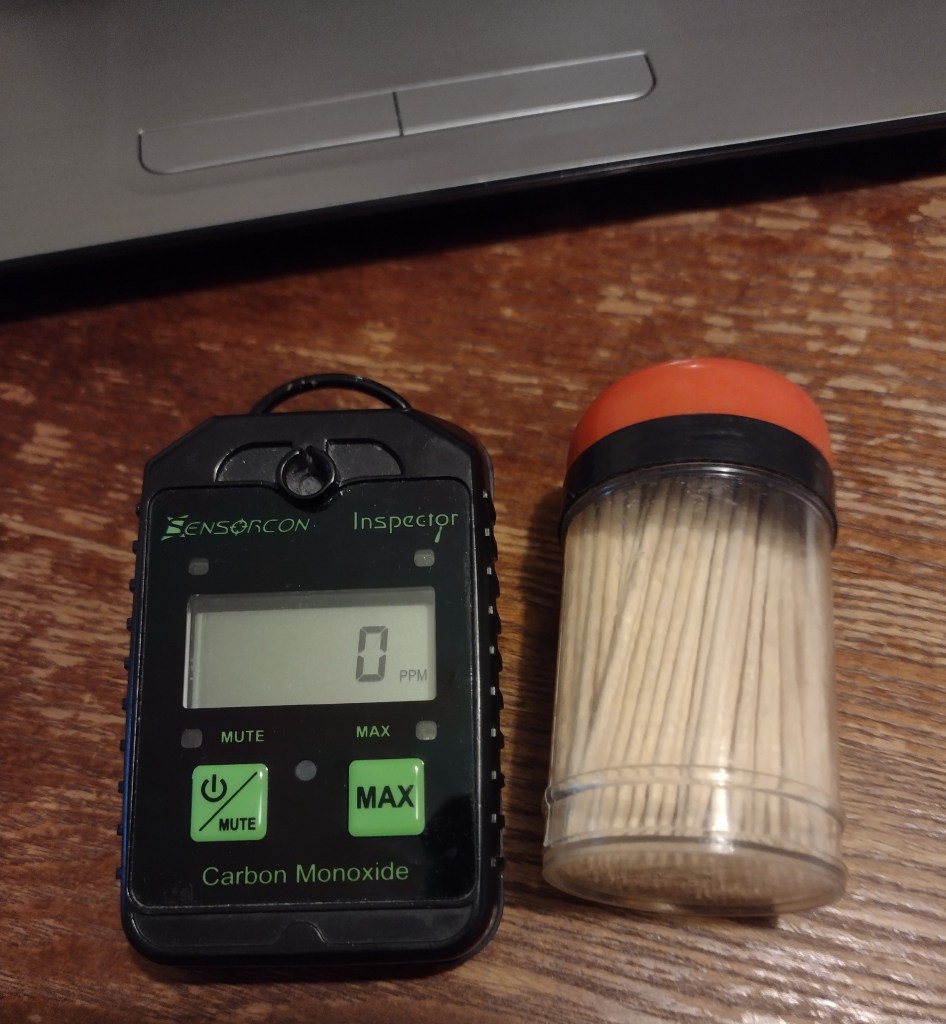
A personal carbon monoxide detector shown next to a case of toothpicks for size. This type of CO detector will pick up levels as low as 1ppm. Ideal for home and travel.
Typical home CO detectors are only designed to prevent death, not poisoning, and will alarm at 70ppm and up.
Many CO related topics are listed below. Please look around. If you are a victim of low level chronic carbon monoxide poisoning, please visit my other pages on this website, as I blog about my own recovery.
I’ll admit some of the research is over my head. If you find this is also the case for you, here’s a tip for reading medical journal articles: Read the opening paragraph (called an abstract) and then scroll down to the “discussion”. These two sections will summarize the article for you. The body in-between is where the technical science is discussed.
Helpful Resources
(This section updated: 1/25/2024)
Is a home carbon monoxide detector enough to keep you safe from poisoning? The answer is NO. Toxicologist Albert Donnay, a leading advocate for the prevention of low level carbon monoxide poisoning explains why HERE.
The National Carbon Monoxide Awareness Association (NCOAA): “The National Carbon Monoxide Awareness Association (NCOAA) is a non-partisan, grassroots, civic-minded organization that is focused on eradicating carbon monoxide poisoning and helping carbon monoxide poisoning survivors recover” https://www.ncoaa.us/
Carbon Monoxide Poisoning. com: A wealth of life saving information provided by attorney Gordon Johnson who specializes in carbon monoxide poisoning.
Chronic CO Poisoning
Video: What You Didn’t Know About Carbon Monoxide Poisoning and Alarms. (2021) National Fire Protection Association “The National Fire Protection Association (NFPA) is a global self-funded nonprofit organization, established in 1896, devoted to eliminating death, injury, property and economic loss due to fire, electrical and related hazards.”
Carbon monoxide poisoning. Is still an underrecognised problem (1999) (I would add that 24 years later we are still in the same boat) “the overwhelming majority of cases go unrecognized, unreported, and untreated. Chronic carbon monoxide exposure is misdiagnosed. A survey carried out by the charity Carbon Monoxide Support showed that in only one case out of 77 was exposure correctly identified on the basis of symptoms alone.”
Chronic and occult carbon monoxide poisoning: we don’t know what we’re missing. “This article reviews the evidence that carbon monoxide is a public health menace even in much lower concentrations.”
Effects on Health of Prolonged Exposure to Low Concentrations of Carbon Monoxide. A wealth of information.
Non-Diseases or CO Poisoning? (2015) “I think it is very telling that more than half the disorders on your list of “non-diseases” are characterized by common–but also commonly overlooked–symptoms of carbon monoxide poisoning”
Occult carbon monoxide poisoning: A cause of winter headache. (1987) “Occult CO poisoning may be an important cause of winter headache.”
A Rare Cause of Chronic Headache that May Be Misdiagnosed as Migraine: Chronic Carbon Monoxide Poisoning. (2014) ” in patients who have the diagnosis of migraine or present with non-specific refractory headaches, chronic carbon monoxide poisoning should be suspected, especially if the attacks occur during the winter months.”
CO & Brain & Nervous System
Carbon monoxide and the nervous system. “Perhaps the most insidious effect of CO poisoning is the delayed development of central nervous system (CNS) impairment within 1–3 weeks, and the neurobehavioral consequences, especially in children. At lower concentrations, CNS effects include reduction in visual perception, manual dexterity, learning, driving performance, and attention level.”
Neuropsychological Impairment From Acute Low-Level Exposure to Carbon Monoxide. “Low-level exposure to carbon monoxide results in impairment of higher cognitive functions.”
Carbon Monoxide Pollution and Neurodevelopment: A Public Health Concern. (2015) “we review overt CO toxicity and the policies regulating CO exposure, detail the evidence suggesting a potential link between CO-associated ambient air pollution, tobacco smoke, and learning and behavioral abnormalities in children, describe the effects of subclinical CO exposure on the brain during development, and provide mechanistic insight into a potential connection between CO exposure and neurodevelopmental outcome. CO can disrupt a number of critical processes in the developing brain, providing a better understanding of how this specific neurotoxin may impair neurodevelopment. “
Neuroimaging, cognitive, and neurobehavioral outcomes following carbon monoxide poisoning (2006) “It is estimated that as high as 50% of individuals with carbon monoxide poisoning will develop neurologic, neurobehavioral, or cognitive sequelae. Carbon monoxide related cognitive impairments included impaired memory, attention, executive function, motor, visual spatial, and slow mental processing speed.”
Aphasia Syndromes (2006) “Often associated with Pick’s disease or carbon monoxide poisoning, mixed transcortical aphasia…The primary remaining language ability is a striking ability to repeat words, phrases, and sometimes whole sentences, the opposite of the conduction aphasic patient. Although articulatory fluency is generally well preserved, the quasiautomatic repetition, often a frank echolalia”
Subacute carbon monoxide poisoning presenting as vertigo and fluctuating low frequency hearing loss. (2018) “Previous literature explains association of CO poisoning and hearing loss due to damage to cochlea, vestibular nerve and central auditory pathways.”
CO & Autoimmunity
Autoimmune Connective Tissue Disease Following Carbon Monoxide Poisoning: A Nationwide Population-Based Cohort Study. “Hypoxia, oxidative stress, and inflammation induced by CO poisoning may increase the risk of autoimmune connective tissue disease through the production of autoantibodies.” https://www.ncbi.nlm.nih.gov/pmc/articles/PMC7686473
Increased risk for hypothyroidism associated with carbon monoxide poisoning: a nationwide population-based cohort study. (2019) “In conclusion, COP (CO Poisoning) was associated with an increased risk for hypothyroidism.”
Oligodendrocyte Dysfunction and Regeneration Failure: A Novel Hypothesis of Delayed Encephalopathy After Carbon Monoxide Poisoning. “Myelin is formed by oligodendrocytes… Myelin damage of DNS is closely related to immune-mediated demyelination, which may be similar to the pathophysiological process of multiple sclerosis (MS)”
How carbon monoxide kills firefighters. (2016) Bruce Evans. “really need to look at the science and at the long-term and chronic exposure issues involving CO …when CO binds to hemoglobin, it also changes the geometry of the hemoglobin molecule…A second carbon monoxide lurking on the fire scene is known as CO in the radical form…A favorite target for the radical CO is the myelin sheath of a nerve cell. A University of Pennsylvania School of Medicine and a National Academies of Science Forum identified long-term effects of CO that parallels the disease process in multiple sclerosis.”
Long-term Effects Of Carbon Monoxide Poisoning Are An Autoimmune Reaction. “CO causes profound changes in myelin basic protein (MBP)”
Association between carbon monoxide poisoning and adrenal insufficiency: a nationwide cohort study. “The risk for developing adrenal insufficiency elevated after COP, especially in female and younger patients…Results of the current study call for monitoring adrenal function of patients with COP.”
PDF: Domestic Gas Appliances and Lung Disease. (1997)
CO & Sensory/Chemical Sensitivity
(Info added to this section 10/24/2023)
Carbon monoxide poisoning and multi-sensitivity – a possible explanation for hypersensitivity symptoms. A good explanation of how CO can cause multi-sensory sensitivity and other hypersensitivities.
Multiple Chemical Sensitivity Referral & Resources (MSCRR): “Professional outreach, patient support, and public advocacy devoted to the diagnosis, treatment, accommodation, and prevention of Multiple Chemical Sensitivity and Multiple Sensory Sensitivity.” Carbon monoxide can cause this. See also: What You Need to Know About CO and Multi Sensory Sensitivity
Neurological Susceptibility to Environmental Exposures: Pathophysiological Mechanisms in Neurodegeneration and Multiple Chemical Sensitivity. “A strong association between pollutant exposure and MCS is evidenced by the onset. Many published papers report the onset of MCS following recognized or well-defined chemical exposure”
CO & Reactive Oxygen Species
Much of the damage from CO poisoning isn’t from hypoxia alone. Reactive Oxygen Species (ROS) is created and causes damage. Definition of ROS: “A type of unstable molecule that contains oxygen and that easily reacts with other molecules in a cell. A build up of reactive oxygen species in cells may cause damage to DNA, RNA, and proteins, and may cause cell death. Reactive oxygen species are free radicals.” (found here)
The role of reactive oxygen species and oxidative stress in carbon monoxide toxicity: An in-depth analysis. “The above-mentioned findings add to the growing body of evidence for oxidative stress in CO intoxication.”
CO & Mitochondria
Carbon monoxide specifically inhibits cytochrome c oxidase of human mitochondrial respiratory chain. “Carbon monoxide is toxic for mitochondria in man, altering the mitochondrial respiratory chain at the cytochrome c oxidase level.”
Alterations in cerebral and cardiac mitochondrial function in a porcine model of acute carbon monoxide poisoning. “Low-dose CO poisoning is associated with early mitochondrial disruption prior to an observable phenotype highlighting the important role of mitochondrial function in the pathology of CO poisoning. This may represent an important intervenable pathway for therapy and intervention.”
CO/Hypoxia & the Gut
Intermittent hypoxia alters gut microbiota diversity in a mouse model of sleep apnoea. (2014) ” hypoxia/re-oxygenation can directly impair cellular function via increases in permeability and bacterial translocation and decreases in tight junction integrity [29]… children with OSA (obstructive sleep apnea) exhibit significantly higher lipopolysaccharide binding protein plasma levels when compared with healthy controls. These results are supportive of the possibility that alterations in the gut microbiota may promote changes in intestinal permeability or, alternatively, induce microbial translocation, all of which could lead to increased levels of systemic lipopolysaccharide. The increased circulating endotoxin levels would then promote innate immunity events…”
CO & Hypoxia in Autism
Prenatal exposure to ambient air pollution and autism spectrum disorders: Results from a family-based case-control study (2022) “Overall, our study found higher exposure to CO and NO2, particularly during the second and third trimesters of pregnancy, was significantly associated with a higher risk of autism.”
Carbon monoxide can come from the environment but also be produced endogenously, especially during stress and inflammation. So it’s hard to say the source in the following article. But interesting and worth noting. Carboxyhemoglobin is “a compound formed in the blood by the binding of carbon monoxide to hemoglobin. It is stable and therefore cannot absorb or transport oxygen.”
Carbon monoxide (CO) correlates with symptom severity, autoimmunity, and responses to probiotics treatment in a cohort of children with autism spectrum disorder (ASD): a post-hoc analysis of a randomized controlled trial (2022) “Interestingly, we first found that the SpCO (carboxyhemoglobin) level was significantly positively correlated with SRS total score at baseline, meaning SpCO could be indicative to ASD core symptom severity”
Endogenous Carbon Monoxide
Carbon Monoxide: Killer to Brain Messenger in One Step. (1993) The role of carbon monoxide as a neurotransmitter.
Carbon Monoxide and Hauntings
(Section added 10/31/2023)
A Tale of a Truly Haunted House (2004) Scroll past the links down to the article.
 The Foggy Noggin' Diner